Intimassy is a private, encrypted diary for your sex life, with cycle and STD tracking for you and your partners.
Ovulation calculator
Last updated:
Enter your last period and your cycle length, or the start dates of your last few periods. The calculator estimates your fertile window, the ovulation day and your next period. It uses the same method as the Intimassy app.
The dates you enter stay in this browser tab. They are not sent anywhere and not saved. Reloading the page clears them. This page uses Google Analytics to count visits and calculator uses. Google Analytics receives no dates and no results.
Your estimate
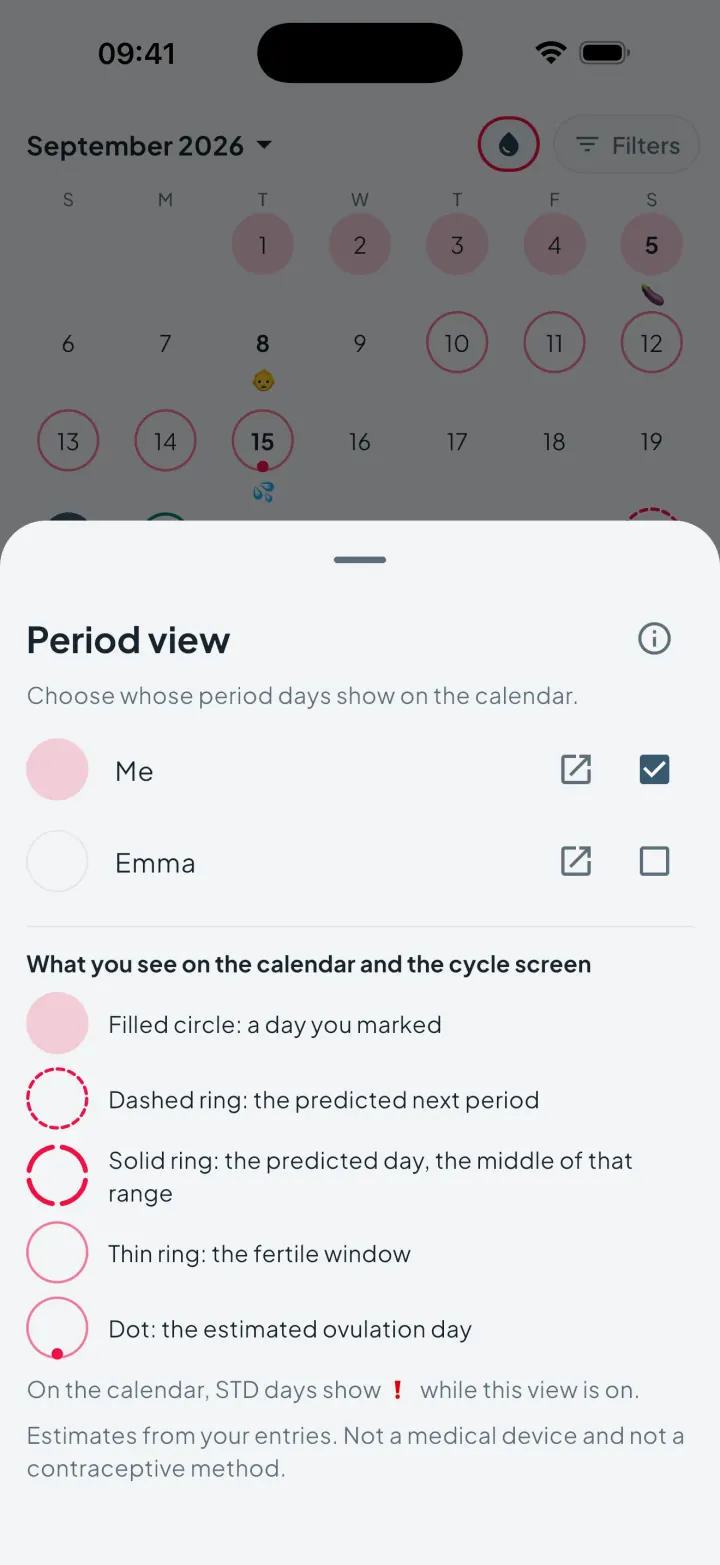
What the marks mean
- Filled circle: a first day you entered
- Dashed ring: the predicted next period
- Solid ring: the predicted day, the middle of that range
- Shaded band: the estimated fertile window
- Dark circle: the estimated ovulation day
- Underlined date: today
Past cycles
Estimates are based on your entries. This is not medical advice, not a medical device and not a contraceptive method.
For medical questions, talk to a doctor.
How this works
The predicted next period
With a cycle length you choose, the prediction is the first day of your last period plus that length. The range around it is 4 days either side, because a single date shows nothing about how much your cycles vary.
With past period dates, the prediction is your most recent period start plus your average cycle length. The average uses your last 6 cycles. A cycle of 99 days or more is not counted. The range widens the more your cycle lengths differ from each other, between 2 and 7 days either side. With only one cycle to measure, it is 4 days.
The fertile window
The estimated ovulation day is 14 days before the predicted next period. The fertile window covers the 5 days before that day, and the day itself. No day after it is included. If a short cycle length would put the window before your last recorded period, it starts at that period instead.
Days outside the window are not safe days. Ovulation moves, and this window is an estimate from your own entries.
Late, and paused
Past the end of the range, the period reads as late, and the fertile window is no longer shown. About a whole cycle late, the calculator stops estimating. Enter the first day of your most recent period to get a new estimate.
Where these numbers come from
The shape of the fertile window comes from published research. Wilcox, Weinberg and Baird (New England Journal of Medicine, 1995) found that conceptions followed intercourse in a six-day period ending on the day of ovulation. That is the window this app draws.
Counting ovulation back 14 days from the next period is a common estimating method, not a measured constant. Published measurements report an average with variation around it, and the averages differ. Lenton, Landgren and Sexton (British Journal of Obstetrics and Gynaecology, 1984) reported about 14 days across 327 phases. Bull and colleagues (npj Digital Medicine, 2019) reported about 12 days across more than 600,000 cycles.
Johnson, Marriott and Zinaman (Current Medical Research and Opinion, 2018) compared calendar rules with measured ovulation days. For a 28-day cycle, even the most likely day was the right one in about 1 in 5 cycles. The study was funded by a company that sells ovulation tests.
The other numbers are choices made for the Intimassy app, not published figures. The average looks at the last 6 cycles. A cycle of 99 days or more counts as a gap. On this page, a cycle length can be 20 to 45 days. The predicted range is held between 2 and 7 days either side.
Studies cited
- Wilcox AJ, Weinberg CR, Baird DD. N Engl J Med. 1995;333(23):1517–1521. doi:10.1056/NEJM199512073332301
- Lenton EA, Landgren BM, Sexton L. Br J Obstet Gynaecol. 1984;91(7):685–689. doi:10.1111/j.1471-0528.1984.tb04831.x
- Bull JR, Rowland SP, Scherwitzl EB, et al. npj Digit Med. 2019;2:83. doi:10.1038/s41746-019-0152-7
- Johnson S, Marriott L, Zinaman M. Curr Med Res Opin. 2018;34(9):1587–1594. doi:10.1080/03007995.2018.1475348
Frequently Asked Questions
How exact is this estimate?
It is an estimate, not a measurement. The calculator counts ovulation 14 days back from the predicted period. That is a common estimating method. Real ovulation moves from cycle to cycle. In a published study, even the best calendar rule named the exact ovulation day in about 1 in 5 cycles. The range around the predicted period shows part of that uncertainty.
Which mode should I use?
Use past period dates if you have them. The calculator then works out your average cycle length, and the range shows how much your cycles vary. Use your cycle length if you only know your last period.
Why does it show only the next period?
Each cycle further ahead adds uncertainty. The calculator shows this cycle's fertile window and the next period only, as the app does.
Are my dates saved or sent anywhere?
No. The calculation runs in your browser. The dates are not sent to us or to Google Analytics, and nothing is saved. Reloading the page clears them.
What does "late" mean in the result?
If today is past the end of the range, the result says how many days late the period is, counted from the predicted day. The fertile window is then hidden. About a whole cycle late, the calculator shows no estimate.
Is this medical advice?
No. This is not medical advice, not a medical device and not a contraceptive method. For medical questions, talk to a doctor.
The same method in the Intimassy app
Intimassy is an app for keeping a record of your sex life. Its cycle feature uses the method on this page. In the app you mark period days as they happen, and it estimates from your last 6 cycles. You can track your own cycle or a partner's.
Download Now